

 Onroad
 Offroad
 Kits
 Electric
 Ready To Race (RTR)
 Nitro
 Drift
 Rock Crawler
 Offroad
 Pickup
 Buggy
 Monster
 Sailing
 Jet
 RTR
 Electric
 High Speed
 Individual Cars
 Sets
 Locomotive & Carriages
 Spare Tracks
 Sets
 Kits
 ACADEMY
 AIRFIX
 ALBION METALS
 APC
 ARRMA
 ARTESANIA
 AXIAL
 BALSA
 BBURAGO
 BLACKZON
 BLADE
 BOB SMITH
 BOLLY
 CASTLE CREATIONS
 DELUXE MATERIALS
 DRAGON
 DUALSKY
 DUBRO
 DUMAS
 EASY MODEL
 ECX
 E-FLITE
 ESTES
 EVERGREEN
 EXCEL
 FIRELANDS
 FLYSKY
 FORCEENGINES
 FTX
 FUNTEK
 FMS RC
 GALAXY
 GEMFAN
 GEN2 BATTERIES
 GENS ACE
 GFORCE
 GREAT PLANES
 GT POWER
 GUILLOWS
 HAIBOXING
 HASEGAWA
 HIMARK
 HITEC
 HOBAO
 HOBBYTECH
 HOBBYWING
 HOBBYZONE
 HORNBY
 HPI RACING
 HUDY
 HUMBROL
 iM RC
 INTELLECT
 ITALERI
 JCONCEPTS
 K&S
 KIMBROUGH
 KINETIC MODELS
 KYOSHO
 LINDBERG
 LOSI
 LOUISE WORLD
 MAGIC MODEL
 MAVERICK
 MILLIPUT
 MUCH MORE RACING
 MULTIPLEX
 MYLAPS
 NOVAROSSI
 NVISION
 NXE BATTERIES
 OS ENGINES
 PANDA HOBBY
 PARKZONE
 PECO
 PRO BOAT
 PROFILM
 PROLINE
 PROTOFORM
 RC 4WD
 REEDY
 REVELL
 RIVER HOBBY VRX
 ROAPEX
 ROBINSON_RACING
 RW
 SAVOX
 SCALEXTRIC
 SCHELLE
 SKYRC
 SOLARFILM
 SPAZSTIX PAINT
 SPEKTRUM
 TAMIYA
 TATTU
 TEAM ASSOCIATED
 TEAM CORALLY
 TEAM MAGIC
 TEAM ORION
 TLR
 TORNADO RC
 TRAXXAS RC ACCESSORIES
 TRUMPETER
 VOLANTEX RC
 XRAY
 ZAP
 ZVEZDA
 Schumacher
How to Choose Your First RC Crawler | RC Hobbyland
Date Posted:28 September 2026
How to Choose Your First R/C Crawler: A Beginner’s Guide
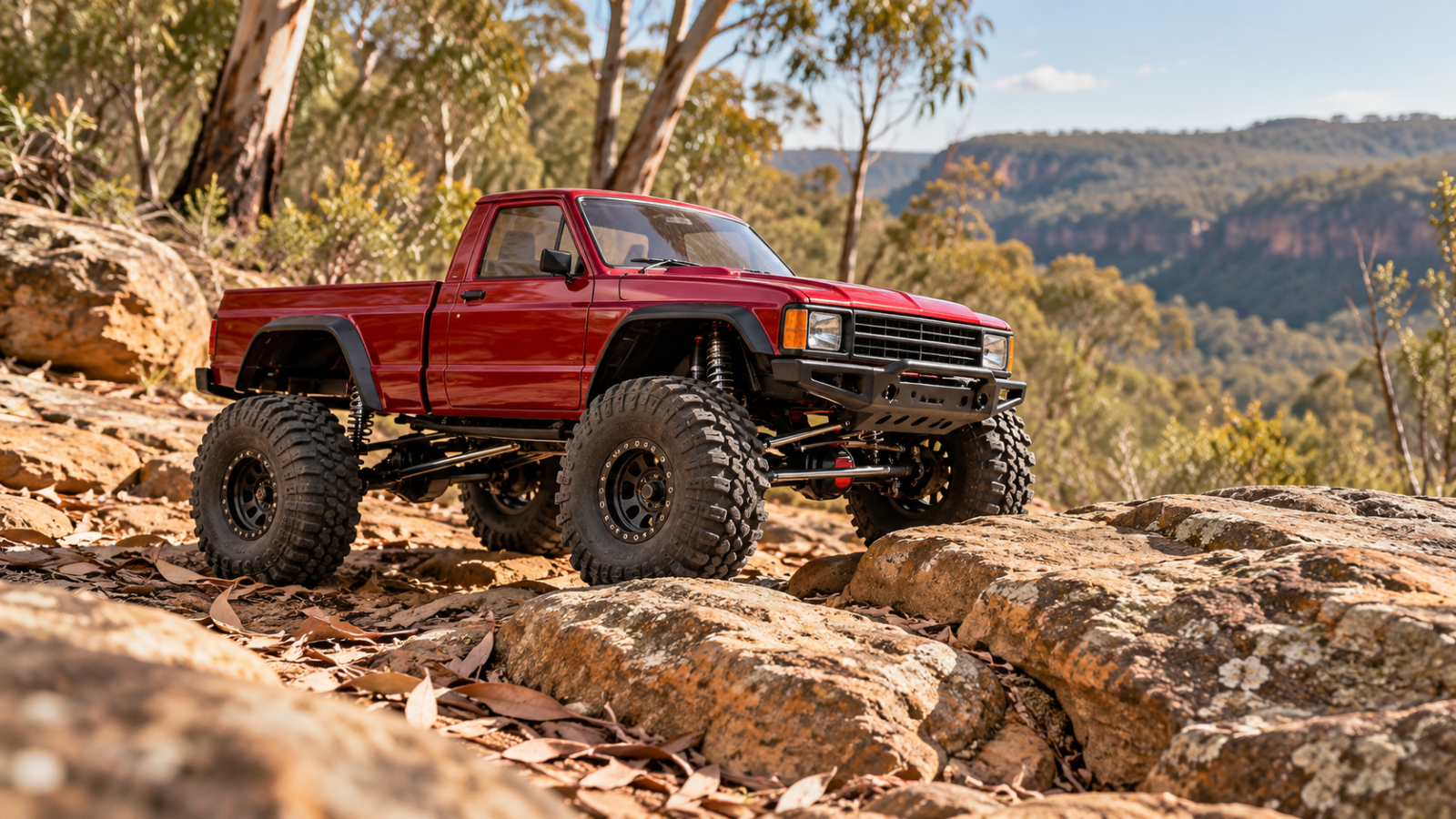
R/C crawling is one of the most enjoyable and accessible parts of the radio-controlled hobby. Instead of focusing purely on speed, an RC crawler uses controlled power, traction and suspension movement to negotiate rocks, trails, timber, garden obstacles and challenging terrain.
Crawlers are available in several sizes and styles, ranging from compact indoor models to highly capable 1/10 scale trail trucks. This guide explains the main differences and will help you choose the right crawler for your experience, driving area and budget.
What Is an RC Crawler?
An RC crawler is a radio-controlled vehicle designed for slow, controlled driving over difficult terrain.
Most crawlers feature:
-
Four-wheel drive
-
High-torque gearing
-
Large, soft off-road tyres
-
Increased ground clearance
-
Flexible suspension
-
Strong steering servos
-
Locked or lockable differentials
-
Good low-speed throttle control
Unlike a racing buggy or monster truck, maximum speed is not the main priority. A crawler is designed to maintain grip and carefully place each wheel while climbing, descending or crossing obstacles.
Where Will You Use Your Crawler?
Your intended driving area is one of the most important considerations when selecting an RC crawler.
Indoor Crawling
Compact 1/24 and 1/18 scale crawlers are ideal for indoor courses. Obstacles can be created using timber blocks, books, cardboard, small rocks and purpose-built crawler ramps.
These smaller models are easy to store, transport and use in limited spaces.
Backyard Crawling
A backyard course can be built using rocks, logs, garden edging, timber and other safe obstacles.
Small crawlers work well on compact courses, while a 1/10 scale crawler will require larger obstacles and more room.
Bush Trails and Outdoor Driving
For outdoor trails, rocks and uneven terrain, a 1/10 scale crawler is usually the most capable option.
Its larger tyres, increased ground clearance and heavier construction allow it to handle terrain that may stop a smaller vehicle.
Technical Rock Crawling
If you want to tackle steep rocks and difficult obstacles, look for a crawler designed more for performance than scale appearance.
A technical crawler may feature a lighter body, low centre of gravity, greater suspension articulation and larger tyres.
Choosing the Right Scale
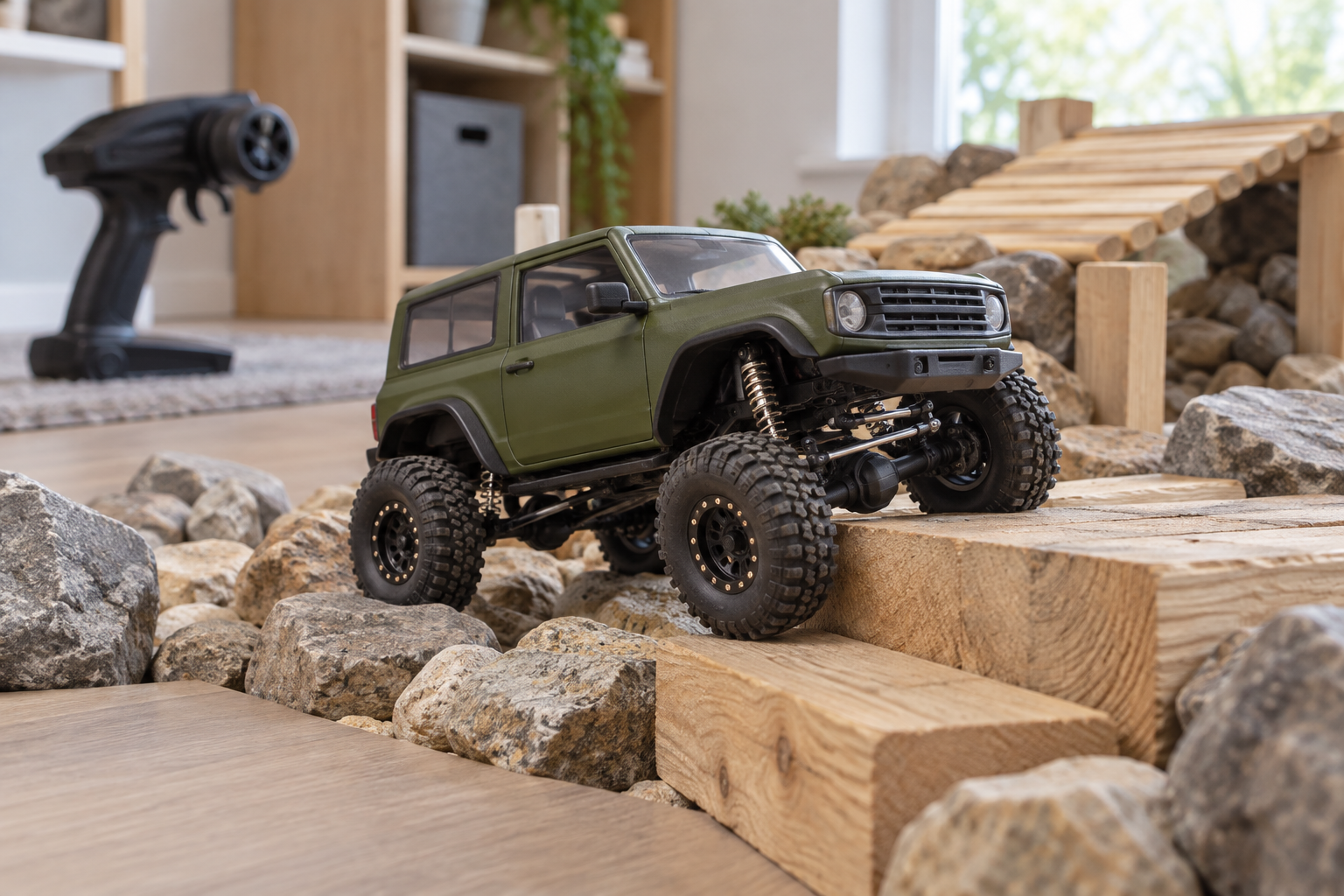
RC crawlers are available in several popular sizes.
1/24 Scale Crawlers
A 1/24 scale crawler is compact enough for indoor use but can still handle small outdoor obstacles.
Advantages include:
-
Easy to store and transport
-
Suitable for indoor courses
-
Lower purchase price
-
Courses can be built in small areas
-
Batteries and accessories are generally affordable
Because of their small tyres and limited ground clearance, 1/24 scale crawlers can struggle with long grass, deep holes and larger outdoor rocks.
1/18 Scale Crawlers
A 1/18 scale crawler offers a useful balance between portability and outdoor ability.
These models are still compact enough for indoor driving but usually have greater ground clearance, larger tyres and better outdoor performance than a 1/24 scale crawler.
They are an excellent choice for someone who wants one crawler for both indoor and light outdoor use.
1/10 Scale Crawlers
The 1/10 scale category is one of the most popular choices for outdoor RC crawling.
A 1/10 crawler provides:
-
Greater ground clearance
-
Larger and more capable tyres
-
Improved performance on outdoor terrain
-
More space for electronics and batteries
-
A wide selection of replacement parts and upgrades
-
Realistic trail-driving performance
These vehicles require more storage space and a larger driving area, but they are generally the best choice for serious outdoor trail use.
Scale Crawler or Performance Crawler?
Not all crawlers are designed for exactly the same purpose.
Scale Crawlers
Scale crawlers are designed to resemble real four-wheel-drive vehicles. They may include detailed bodies, lights, mirrors, roof racks, interiors and other realistic accessories.
They are ideal for trail driving and anyone who values realistic appearance.
However, heavy scale accessories can raise the vehicle’s centre of gravity and may reduce its ability on very steep or technical obstacles.
Performance Crawlers
Performance-focused crawlers place climbing ability ahead of realistic appearance.
They often use lightweight bodies, carefully positioned components, wide suspension movement and aggressive tyres. These features can provide better stability and grip on difficult rock sections.
Trail Crawlers
Trail crawlers combine realistic styling with useful off-road performance.
For many beginners, a trail crawler is the best all-round option because it can handle rocks, dirt tracks, bush trails and general recreational driving.
Ready-to-Run, Kit or Roller?
RC crawlers are available in different completion levels.
Ready-to-Run – RTR
An RTR crawler is assembled and normally includes the motor, speed controller, steering servo, receiver and transmitter.
Some RTR packages also include the main battery and charger, while others require them to be purchased separately. Always check the package contents and “needed to complete” section before ordering.
For most beginners, an RTR crawler is the easiest and most convenient choice.
Assembly Kit
A crawler kit requires assembly and may also require separate electronics, wheels, tyres, body paint and radio equipment.
Building a kit is an excellent way to learn how the drivetrain and suspension work, but it requires more time, tools and technical knowledge.
Roller or Chassis
A roller is generally an assembled chassis that requires some or all of its electronics.
This option is better suited to experienced hobbyists who want to select their own motor, speed controller, servo and radio system.
Brushed or Brushless Motor?
Both brushed and brushless systems can be used in RC crawlers.
Brushed Motors
Brushed motors are common in beginner and ready-to-run crawlers.
They are affordable, simple and can provide excellent low-speed control. A brushed crawler is more than suitable for most first-time users.
Brushless Motors
A quality brushless crawler system can provide smooth low-speed control, greater efficiency and reduced motor maintenance.
However, brushless systems generally increase the price of the vehicle. Not every high-speed brushless system is suitable for crawling, so the system must be designed or programmed for controlled low-speed use.
For a first crawler, smooth throttle response is more important than maximum power.
Why Tyres Matter
Tyres are one of the most important parts of an RC crawler.
A good crawler tyre uses a soft rubber compound and an open tread pattern that can grip rocks, dirt and timber. Internal foam or tyre inserts support the vehicle while allowing the tyre to conform to the surface.
Consider the terrain you intend to use:
-
Soft, open tread patterns work well on loose dirt and rocks.
-
Taller tyres can provide additional ground clearance.
-
Softer compounds generally provide increased grip.
-
Firmer inserts can improve sidewall support on heavier crawlers.
Larger tyres can improve clearance, but fitting tyres that are too large may cause rubbing, increase strain on the steering servo or affect the vehicle’s gearing.
Suspension and Articulation
Suspension articulation allows the wheels to move independently over uneven terrain while helping the other tyres remain in contact with the ground.
More articulation is not always automatically better. Excessive movement can make a crawler unpredictable or allow the body to lean too far.
A well-designed crawler should have controlled suspension movement, stable weight distribution and enough clearance to cross uneven obstacles.
Ground Clearance and Body Angles
Several measurements affect a crawler’s ability to negotiate obstacles.
Ground Clearance
Ground clearance is the distance between the lowest part of the vehicle and the ground. Increased clearance helps the crawler pass over rocks and obstacles.
Approach Angle
The approach angle determines how steep an obstacle the front of the crawler can reach without the bumper making contact first.
Departure Angle
The departure angle affects whether the rear bumper or body catches as the crawler moves away from an obstacle.
Breakover Angle
The breakover angle relates to the crawler’s ability to cross the top of an obstacle without becoming caught underneath the centre of the chassis.
Tyre size, wheelbase and chassis design all influence these measurements.
Portal Axles and Standard Axles
Some crawlers use portal axles, which position reduction gears near the wheels. This raises the main axle housing and can provide additional ground clearance.
Portal axles can also reduce torque load through parts of the drivetrain.
Standard straight axles are simpler and can provide a lower centre of gravity. Both designs can perform extremely well, so portal axles should be considered a useful feature rather than an essential requirement for every beginner.
Two-Speed Transmissions and Lockable Differentials
Some crawlers include additional features such as a two-speed transmission or remotely lockable differentials.
A two-speed transmission provides a low gear for technical crawling and a higher gear for travelling between obstacles.
Lockable differentials allow the vehicle to turn more naturally when unlocked and provide maximum traction when locked.
These features can add versatility, but they also add servos and moving components. A simple single-speed crawler with permanently locked differentials may be easier for a beginner to maintain.
Steering Servo
Crawling places considerable load on the steering servo, especially when the tyres are wedged against rocks.
A suitable crawler servo should provide strong torque and reliable gears. Metal-geared servos are generally preferred for heavier vehicles and demanding terrain.
Small-scale crawlers use smaller servos, so replacements must match the mounting dimensions and electronic requirements of the vehicle.
Battery and Charger Requirements
Many smaller RTR crawlers include a battery and USB charger. Larger models may require a separate battery and charger.
Before purchasing a battery, check:
-
Battery chemistry
-
Voltage and cell count
-
Physical dimensions
-
Connector type
-
Manufacturer recommendations
-
Speed controller compatibility
LiPo batteries provide excellent performance but must be charged, handled and stored correctly. Always use a compatible balance charger, follow the manufacturer’s instructions and never leave a charging battery unattended.
Water-Resistant Does Not Mean Waterproof
Many crawlers are advertised with water-resistant electronics, but this does not necessarily mean the vehicle can be fully submerged.
Water can also affect bearings, gears, screws and other metal components. After driving in wet or muddy conditions, clean and dry the crawler and inspect it before storage.
Always follow the manufacturer’s instructions regarding water exposure.
Replacement Parts and Upgrade Support
RC crawlers are designed to be maintained, repaired and customised.
Before selecting a model, consider:
-
Are replacement suspension and drivetrain parts available?
-
Can individual electronic components be replaced?
-
Are optional wheels, tyres and bodies available?
-
Does the manufacturer provide a parts diagram?
-
Are batteries and connectors easy to obtain?
-
Is local product support available?
Good spare-parts availability is often more valuable than choosing a vehicle based only on its advertised features.
Allow for the Complete Cost
Depending on the crawler package, you may also need:
-
A suitable battery
-
A compatible charger
-
AA or AAA transmitter batteries
-
Basic metric hex tools
-
A LiPo charging and storage bag
-
Spare body clips
-
Replacement tyres or commonly used spare parts
Checking the complete requirements before ordering will help ensure you can use your new crawler when it arrives.
Which Crawler Is Right for You?
Choose a 1/24 scale crawler if you mainly want to drive indoors, have limited space or want an affordable introduction to crawling.
Choose a 1/18 scale crawler if you want a portable model that can handle both indoor courses and lighter outdoor trails.
Choose a 1/10 scale crawler if you want to explore outdoor trails, tackle larger rocks or build a highly customisable vehicle.
Choose a scale crawler if realistic appearance and trail driving are most important.
Choose a performance crawler if climbing difficult obstacles is your main goal.
For the easiest starting experience, select an RTR crawler that includes the correct battery and charger.
Common Beginner Mistakes
Choosing by Appearance Alone
A highly detailed crawler may look impressive, but consider its weight, ground clearance, tyre performance and spare-parts support as well.
Buying the Wrong Size
A 1/24 crawler may be too small for rough bush trails, while a 1/10 crawler may be too large for a compact indoor course.
Focusing on Speed
Crawling is about control, traction and accurate wheel placement. Extra speed does not necessarily improve crawling performance.
Adding Too Much Weight Up High
Roof racks, spare tyres and accessories can make a crawler look realistic, but excessive weight above the chassis can cause it to tip more easily.
Purchasing an Incorrect Battery
The connector may fit while the voltage or battery dimensions are unsuitable. Always check every compatibility requirement.
Upgrading Before Driving
Use the crawler in its standard form before purchasing upgrades. This will help you identify which changes would genuinely improve its performance.
Final Beginner’s Checklist
Before choosing your first RC crawler, ask yourself:
-
Will I drive indoors, outdoors or both?
-
What scale suits my available space?
-
Do I prefer realistic trail driving or technical climbing?
-
Do I want an RTR model or an assembly kit?
-
Are the battery and charger included?
-
Are replacement parts readily available?
-
Is the steering servo suitable for the vehicle?
-
Does the crawler have suitable tyres?
-
What is my complete budget?
Find Your First RC Crawler
The best beginner crawler is not necessarily the most expensive or the one with the most features. It should suit your driving area, experience, budget and preferred style of crawling.
Browse RC Hobbyland’s range of RC rock crawlers in compact and full-size options.
If you need help choosing, let the RC Hobbyland team know where you plan to drive, which scale interests you and your approximate budget. We can help you select a suitable crawler and make sure you have the correct battery, charger and accessories.


